Managing the risk to health and safety is a duty that reduces the severity of injury or illness and promotes awareness of potential hazards. In the case of fire management, it may mean the difference between the loss of life and loss of property. It should always be remembered that loss of property can be replaced and handled but the loss of life cannot. It will depend on the nature of the site, the size and location, the hazards and chemicals stored on the site as to the factors that need to be taken into account when deciding what fire management needs to be provided.
Fire is the rapid oxidation of material/s in the exothermic chemical process of combustion, releasing light, heat and various reaction processes. The potential for damages to both person/s and property is very high when arrangements for the event of a fire are not prepared and practiced. The main objective during a fire is to protect people.
There are three elements that are required for a fire to survive. An example of this can be found on the fire triangle.

When any one of these elements is removed from the fire, the fire will extinguish. For example, if you pour water on the fire you are cooling the heat and hence the fire is extinguished. If you cover the fire you are starving it of oxygen and the fire is extinguished. If you remove the matter that is fueling the fire i.e. carbon matter, gas, electricity, then the fire will extinguish. The caveat here is that fire is so destructive that often the fuel that initiated the fire becomes part of multiple fuels as other items begin to burn. i.e. a gas fire starts and the gas is turned off - that initial fire may be out but the carbon matter around it may have ignited to start another fire.
Knowing how to extinguish a fire is a skill that should be taught at an accredited level only with properly trained personnel. The learning in this section is for information purposes only - if you have not been properly trained to fight a fire then you should immediately call emergency services in the event of a fire or allow those that have been trained to take the lead in the situation.
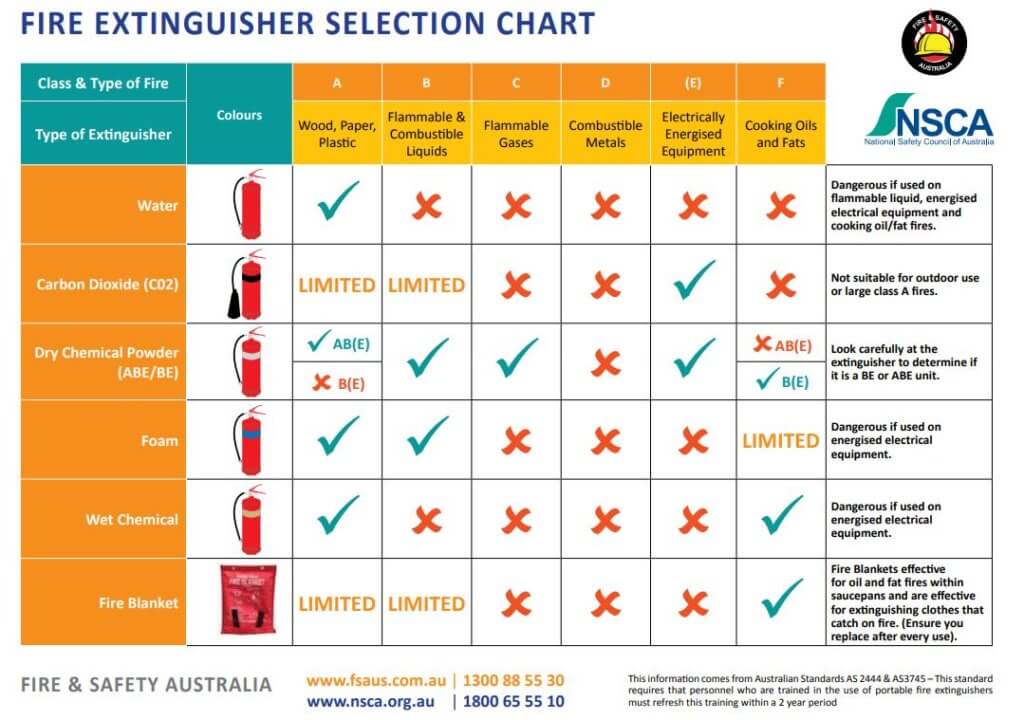
Types of fires and their correlating extinguishers.
Combustible Fuels
Typical fire fuels include;
Knowing about fire fuels will make it easier to recognise the many fire hazards that could be present on your site.
A little known fact - moist grass clippings generate heat and when the gas that they produce is exposed to oxygen, this occurrence causes the material to ignite and catch fire. Piles of grass clippings are a dangerous practice and should be reconsidered for a safer method of disposal.
Sources of Heat
Fires are started and kept going by heat. A key element to the prevention of fire is to remove heat sources that are potential risks - or keep them away from combustible fuels.
Open flames and sparks are a common source of heat that will ignite a fire;
Highly flammable materials such as flammable gases and vapours can be ignited by sparks. Some examples of items that can spark are;
Surface heat is a common result from items that have electricty running through them for long perods of time or sit on stand-by. Examples of this are;
Electrical Equipment and Cable Management
To minimise electrical malfunction risk in the church, it is important to manage the electrical equipment in a specialised register and inspection log. The training required to perform this task is an accredited course, UEENEEP026A - Conduct In-Service Safety Testing of Electrical Cord Connected Equipment and Cord Assemblies. Hazards from electrical equipment or installations may arise from;
A hostile operating environment is exposure to mechanical damage, moisture, heat vibration, corrosive substances or dust.
A person with this accredited qualification must attend to your asset register and individually test each item with;
Regular inspection and testing should be ensured in accordance with the Australian Safety Standard AS3760:210. A risk assessment should be carried out to determine how often electrical equipment should be tested in your church with consideration to the hazards from electrical equipment or installations. In any case, all electrical equipment should be tested at least once every 12 months and logged in a special testing logbook.
Testing and tagging the electrical equipment will determine whether there are any potential risk that could cause malfunction, potential ignition sources and operator burns or electrocution.
Role of Fire and Rescue NSW (FRNSW)
FRNSW are a government funded service provided to;
These responsibilities are underpinned by these four key principles;
FRNSW provide commuinty engagement to help prevent fire, injury and loss by means of;
Only those that are trained to use firefighting equipment should fight a fire and then only if it is safe to do so.
Fire Safety Certificates and Statements
Under the provision of the Environmental Planning and Assessment Regulation 2000, owners of buildings have a legal obligation to supply the Commissioner of the NSW Fire Brigades with a copy of a fire safety certificate statement listing the fire safety measures applicable to their building.
This requirement applied to public buildings including but not limited to schools, shared accommodation buildings, churches, offices, etc.
Each building requires a fire safety certificate to be displayed prominently within the building. This will list the essential equipment services (fire extinguishers, emergency lighting, etc.) required. An annual statement must also be displayed. Both documents must be completed by a suitably qualified person. Significant penalties may be applied.
Some of the essential critical fire safety measures that would be included on an annual safety statement are;
For further information, you can contact the Fire Safety Division of the Fire Brigades. firesafety.fire.nsw.gov.au
