Providing immediate and effective first aid to people who have become injured or ill may reduce the severity of the injury or illness and promote recovery. In some cases, it may mean the difference between life and death.
First aid arrangements will vary from one place to the next. It will depend upon the nature of activities undertaken on the site, the type of hazards present on the site, the size and location of the site as well as the number of people that attend the site. All of these factors need to be taken into account when deciding what first aid requirement needs to be provided.
In todays climate of litigation there are fears that by performing first aid on a person there is risk of personal liability. During training this fear is allayed - by operating within the training and only providing treatment that is trained, no first aider can be found personally liable.
Nearly all Australian states and territories have in place good Samaritan legislation to ensure that people who step forward to provide emergency medical assistance are not held legally liable for their actions provided they act in good faith (Civil Laws (Wrongs) Act 2002 (ACT) s 5; Civil Liability Act 2002 (NSW) s 57
The Risk Management Process
The following is important to involve in the assessment of what approach you will take towards your first aid facilitation;
Giving the opportunity for consultation involves the sharing of information and the opportunity for feedback. It should be done before making decisions about health and safety matters.
Section 47 of the WHS Act 2011
A person conducting a business or undertaking must consult, so far as reasonably practicable, with workers who carry out work for a business or undertaking who are (or likely to be) directly affected by a work health and safety matter.
First Aiders Regulation 42 - Duty to provide first aid.
A person conducting business or undertaking must ensure that an adequate number of workers are trained to administer first aid at the workplace or that workers have access to an adequate number of other people who have been trained to administer first aid.
First aiders must hold a nationally recognised certification issued by a rescued training organisation (RTO) for the nationally endorsed first aid unit/s of competency.
First aid can be provided in your local church in a number of way;
Additional Training for First Aiders
First aiders should attend training on a regular basis to refresh their first aid knowledge and skills and to confirm their competence to provide first aid. Refresher training in CPR should be undertaken annually and first aid qualifications should be renewed every three years.
It is a recommended code of practice to undertake additional first aid training to respond to specific situations at their church i.e. where severe allergies could be a potential risk, first aiders should be trained to respond to anaphylaxis.
Number of Trained First Aiders
The number of first aiders depends on the risk level at your local church. Therefore, the risk management process is an important factor in assigning the number of trained first aiders.
The following ratios are recommended;
The number and type of trained first aiders can be further refined by the following five-step guide;
First Aid Procedures
The local church should develop and implement first aid procedures to ensure that everyone has a clear understanding of first aid in the church. The procedure should cover;
Record Keeping
A record of first aid treatment given should be kept by the first aider and reported to the board on a regular basis to assist reviewing first aid arrangements and assessing any potential hazards that are causing risk. First aid treatment records are subject to requirements under Health Records Legislation.
The Nature of Potential Hazards in the Church
Certain work environments have a greater risk of injury and illness due to the nature of work or activity carried out and the nature of the hazards on site. For example, a food pantry will have a greater risk of injury requiring immediate medical treatment than the person working in the church library. This is why it is important to undertake the Risk Management process to determine the types of potential hazards that cause risk and the first aid arrangements that you will have in place in the event of an injury.
Signage
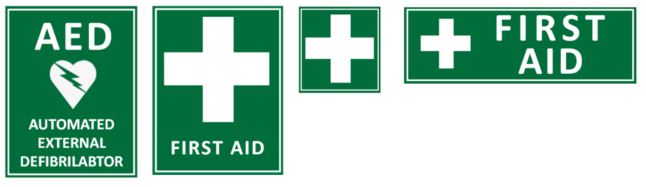
The Australian Standard for safety signs for the occupational environment states that safety and emergency signs should comprise of white text in a green background.
Displaying well-recognised first aid signs will assist in an easy experience locating the equipment and/or facilities - especially in the event of an emergency.
Other First Aid Equipment and Facilities
In addition to first aid kits, it should be considered whether other first aid equipment is appropriate according to the results from the risk management process. Some examples may be;
NNSW First Aid Arrangements
The North New South Wales Conference has an arrangement with ALSCO training and can help to facilitate the training of the local church first aid team. Please make contact if you seek to enquire through the main office line (02) 4951 8088
